Have You Denied Jesus?

How many of you have been in a group and someone makes a comment about Christians? Why is it that the world hates a follower of Christ who takes a stand for what is right and just? Have you ever been somewhere and heard someone say the word GD? A true follower of Christ would be offended and yet so many professing Christians think that it is excusable because they do not want to be labeled as fanatics. They are very accepting of filthy talk or curse words using God’s name in vain.

I recently was in a group of professionals on Facebook. The moderator of the group posted a picture that many would deem to be soft pornography. He made a comment about her wanting to join the group. I saw it, was offended, and sent him a personal email to request that he remove it. I gave many reasons, but the most important reason was that it was inappropriate. He never responded so I posted that I was resigning from the group and took a stand. Pornography has no place in professional Facebook pages much less on someone’s site who professes to be a Christian. Since then, I saw many hateful comments pertaining to my stance including his own comments of people need to accept him for him being him. But the issue here is a sin issue.

I wonder how many of you reading this have denied that you were a Christian? How many have kept silent when friends, co-workers, or even your boss made hateful statements about Christians or about Jesus or God the Father? Is keeping silent denying that you know Jesus Christ as your savior?

Let’s look at what the Bible says about denying Christ. Luke 12:8-12, “And I tell you, everyone who acknowledges me before men, the Son of Man also will acknowledge before the angels of God, but the one who denies me before men will be denied before the angels of God. 10 And everyone who speaks a word against the Son of Man will be forgiven, but the one who blasphemes against the Holy Spirit will not be forgiven. 11 And when they bring you before the synagogues and the rulers and the authorities, do not be anxious about how you should defend yourself or what you should say, 12 for the Holy Spirit will teach you in that very hour what you ought to say.”

If we deny Christ, then He will deny us before the angels of God. Therefore, be bold in your faith. Do not cave to the pressures of the politically correct. But when you are professing Christ as your Savior, also show the love and humility of Christ. When people treat you wrongly, then show love back in return. The Bible says that it would be like heaping hot coals on their heads. It is something that they would not expect (cf. Romans 12:20).

Heaping hot coals reminds me of when I was twelve years old, a bully lived in my neighborhood by the name of Mike. I feared him and typically ran every time I saw him. I could sense that he was very evil and was the neighborhood bully. One afternoon, he caught me across the street visiting a neighbor. He came across the street and said that he wanted to fight me. I did not run, but stood my ground and told him that I was not going to fight. Then he drew his fist back and punched me right in the mouth. Then suddenly, I smiled at him with the blood running down out of my mouth and said that I forgave him and that I loved him. The neighbor could not believe what he heard and with that, Mike walked away. Yes, he punched me in the mouth, burst my lips, and bloodied my gums, but he did not have victory. Jesus took the victory that day. I forgave him and smiled and burst out laughing. He must have thought I was crazy, but I was grounded in the Lord. By my actions that day, I know that I heaped hot coals on Mike’s head, but I returned love to him, even when he did not deserve it.

Let’s look at one more verse. In verse ten, “And everyone who speaks a word against the Son of Man will be forgiven, but the one who blasphemes against the Holy Spirit will not be forgiven. “ What does it mean to blaspheme the Holy Spirit? According to R.C. Sproul, “Blasphemy against the Holy Spirit attributes to Satan the work of the Holy Spirit through Christ in the face of overwhelming evidence to the contrary. Such deliberate rejection of the truth is a decisive rejection of the One who can bring a person to repentance and faith, such intentional and defiant sin makes forgiveness impossible.”[1]

Hopefully, you will see that Jesus wants you to truly follow Him and not only when it is convenient. Having a true relationship with Christ means that you are totally committed to Him. It means that when you wake up in the morning, you are thinking about God the Father and Jesus His Son. All throughout the day, you are talking with Christ through your mind and in your heart. It means that when you go to bed, the very last thing you think of is His love and how thankful you are to be called a child of God. Following Christ is a total commitment, to trust Him in all your daily dealings. Do not deny Christ in your actions each day to others. You may not deny him by mouth, but willful sin is a denial.

If you want to follow Jesus and accept him as your personal Savior, pray this prayer: “Dear Jesus, I am a sinner. I confess my sins to you. Please forgive me and come into my heart. I promise to live for you and serve you all the days of my life. I believe that you died for me and that you also rose again on the third day. Please come into my life and transform my heart. In Jesus Name, Amen.”

Notes:

[1] R.C. Sproul, General Editor, The Reformation Study Bible: Condensed Edition English Standard Version (Orlando, FL: Reformation Trust Publishing, 2017), 1551.

Joseph T. Lee, Copyright © May 21, 2018. The Lantern & Shield Times LLC. All Rights Reserved.

Philosophy of Small Groups

Introduction

Small relational groups are essential in making disciples for the health of the body of Christ through authentic and genuine lifestyles of the disciple-maker. The sharing of life and modeling will help to define the philosophy of the relational group, which in turn will encourage the disciples to missions within the local, national, and international community.

My Philosophy of Small Groups in a Church or Ministry Organization

My philosophy of small groups within a church or ministry organization is constantly being developed. I can see the need for small groups, since the leader can maintain more control over the group as well as keep it on track as to its ultimate destination. A small group is more intimate and the members can get to know each other much better. It is through relationships where the group will become much stronger so they can forge ahead and accomplish the goal of the group. For instance, I plan on starting a “Share Jesus Without Fear” group, to teach others how to share their faith and evangelize. The goal of the group will be evangelism which will lead to discipleship. Having a small group will make it easier to stay in control as well as teach and help those who may not be grasping the material well.  A larger group would not afford the intimacy of a small group.

The Importance of the Relational Group in Authentic Disciple Making

Disciple makers leading small groups must intentionally pursue a relationship with their disciple mentees through genuine and authentic interactions. According to Jim Putman, Bobby Harrington, and Robert E. Coleman, “Jesus himself made disciples using a variety of methods and activities, yet his goal was always discipleship.”[1] For relationships to occur, the leader must be willing to be open in his or her small group. Sharing life together is important, but they must also allow others to see their humanness as well. For instance, pastors and disciple makers are not perfect. They have problems as well as sin in their own lives. By being open and honest with one another, this can forge a true and open relationship so that the group members can pray for one another. Putman et al. wrote, “We believe in the priesthood of every believer, and we want to get people into the game.”[2] Since every believer is called to be a minister to others, then members of the small relational group can certainly minister to their own leader by praying and showing love to one another.

Putman et al. states “Making disciples in biblical relational contexts can work well to reach the world for Jesus, one person at a time. The relational small group forms the backbone for discipleship.”[3] A small group must have a defining purpose so that it can stay on course with its vision and goal. If the group’s purpose leads back to making disciples, then it is on target to succeed. Putman et al. wrote, “A biblically based, disciple-making small group involves three components. It’s (1) a place where shepherding takes place, (2) a place where real teaching takes place with Q&A, modeling, and stories, and (3) a place where authenticity and accountability are encountered and modeled.”[4]  Taking these steps can lead to a healthy small relational group which will strengthen the body of Christ.

Missional Groups Can Help the Body of Christ Move into the Community

Missional groups can help the body of Christ move into the community. As mentioned previously, there must be a purpose and a vision to stay on track. Rod Dempsey wrote,

‘In the Great Commission, the command to ‘make disciples’ is clear. In the final instructions from Jesus to His disciples, we have some clues about how to go about making disciples regardless of the model. We must be going. We must be going to all nations. We must be preaching the gospel. We must die to self and be witnesses (martyrs) for Christ. We must be going and making disciples, which includes baptizing and teaching them to observe (obey) everything that Christ commanded. We must wait on the Spirit of promise to go with us.’[5]

I found Dempsey interesting when he wrote about Neil Cole’s book, Church 3.0. Dempsey wrote,

“Neil Cole in his book Church 3.0 argues that historically, the church has had three operating systems. The first system was organic and functioned around the idea of a people movement. The second system rejected this system and morphed into a professional clergy-driven model. The third operating system is a return to the family/body operating system where every person is important to the health of the church.”[6]

What I found interesting was that church as we know today (Church 2.0) has been conducting itself as a place where people have gone for the last 1700 years. Cole asserts that in Church 2.0. the ministry setting is at the meeting place, which is a church building. The new emerging church is Church 3.0 in which the ministry setting is in the marketplace. In other words, instead of teaching disciples to disciple within the confines of the church physical building walls, Church 3.0 is sending disciples into the community and the world to evangelize and make disciples. I truly believe that is what Christ truly meant when he stated that we were to take the gospel to Jerusalem, Judea, Samaria, and the utmost parts of the world (Acts 1:8). The church posture is that we all go. We all minister since we all as believers are called into priesthood.[7] Another interesting comparison is that growth in our current Church 2.0 is based on addition where in 3.0, it is based on multiplication.[8] Dempsey wrote, “Missions: people are encouraged to live as missionaries and go across the street and across the world.”[9]

My Status of Living in the Community

My status of living in the community identifies more with Church 3.0. I have started a ministry called Marketplace Evangelism Ministries, which focuses on taking the gospel into the workplace through evangelism. I share my faith with corporate business owners. If they come to Christ, then I take them on as disciples to teach them how to share the gospel with others and ultimately, they start to make disciples. Many times, my activity leads me to others in the marketplace who may not be business owners, but employees who want a true relationship with Jesus Christ. I will never turn down an opportunity to witness, but my focus is to stay within the confines of the marketplace to stay on track with the vision of the ministry.

Being Missional in the Community

Within my own community, I can be missional by living my life as a man of God, by praying for those I meet, helping when I see a need to help, and when people come to Christ, encouraging them to live a life of Christ as well as taking them on as a disciple of Christ. Don N. Howell wrote, “Jesus referred to himself as the Son of man who walks among people offering redemption to lost sinners, proclaiming God’s inaugural rule, and experiencing loss, persecution, and betrayal.”[10] Living my life as a follower of Jesus Christ and intentionally investing in the lives of others through relational discipleship can make a difference for the cause of Christ. As Christ lived among the people, we all should be living among the people and testifying and sharing our faith. Dietrich Bonhoeffer wrote, “The Christian community thus lives its own life in the midst of this world, continually bearing witness in all it is and does that ‘the present form of this world is passing away’ (1 Cor. 7:31), that time has come short (1 Cor. 7:23), and that the Lord is near (Phil. 4:5).”[11] As Bonhoeffer asserts, we must be living our life in the world in order for the world to be changed. The time is short and the second coming of Christ is near. According to Dave Earley, “A Christian missionary is a person with the mission of positively impacting others with the life-changing message of Jesus Christ.”[12] Therefore it is so important that every believer live their life as ministers of the gospel and missionaries. The only way to do this is that everyone must become engaged in taking the gospel across the street and ultimately across the world.

Conclusion

In conclusion, we are all called into priesthood as followers of Jesus Christ. This is accomplished by training all church members to be missionaries for the cause of Christ. This can be done by developing small relational groups with the ultimate focus of discipleship. The group can be whatever, as long as it leads to discipleship. As mentioned previously, “A biblically based, disciple-making small group involves three components. It is a place where shepherding takes place, a place where real teaching takes place with Q&A, modeling, and stories, and a place where authenticity and accountability are encountered and modeled.”[13]

By implementing these types of groups, it can lead to these newly trained disciples to take the gospel out into the community to minister to neighbors, as well as their local community. These new disciples can then start their own ministries and multiply by making disciples who in turn make disciples. By training new followers of Christ to be missional, then they can take the church into the marketplace to evangelize and make disciples. As Cole asserts, we must all become engaged in the business of ministering to each other as well as in the harvest fields of our communities. Dempsey states to see life transformations, we must follow Colossians 1:28, “We proclaim Him, admonishing every man and teaching every man with all wisdom, so that we may present every man complete in Christ. Our goal as Christian leaders is to help every individual stand before the King of kings and hear from Him: ‘Well done, good and faithful servant.’”[14] It is my hope through Marketplace Evangelism Ministries that we can do just that.

Bibliography

Bonhoeffer, Dietrich. Dietrich Bonhoeffer Works, Volume 4. Minneapolis, MN: First Fortress Press, 2003.

Earley, Dave, and David Wheeler. Evangelism Is…: How to Share Jesus with Passion and Confidence. Nashville, TN: B&H Publishing Group, 2010.

Earley, Dave, and Rod Dempsey. Disciple Making Is… How to Live the Great Commission with Passion and Confidence. Nashville, TN: B&H Academic, 2013.

Howell, Jr., Don N. Servants of the Servant: A Biblical Theology of Leadership. Eugene, OR: Wipf & Stock Publishers, 2003.

Putman, Jim, Bobby Harrington, and Robert E Coleman. Disciple Shift: Five Steps That Help Your Church to Make Disciples Who Make Disciples. Grand Rapids, MI: Zondervan, 2013.

Notes:

[1] Jim Putman, Bobby Harrington, and Robert E. Coleman, DiscipleShift: Five Steps that Help Your Church to Make Disciples Who Make Disciples (Grand Rapids, MI: Zondervan, 2013), 177.

[2] Ibid., 170.

[3] Ibid., 196.

[4] Ibid., 197.

[5] Dave Earley and Rod Dempsey, Disciple Making Is…: How to Live the Great Commission with Passion and Confidence (Nashville, TN: B&H Publishing Group, 2013), 275-276.

[6] Earley and Dempsey, Disciple Making Is, 276.

[7] Earley and Dempsey, Disciple Making Is, 277.

[8] Earley and Dempsey, Disciple Making Is, 277.

[9] Earley and Dempsey, Disciple Making Is, 280.

[10] Don N. Howell, Jr., Servants of the Servant: A Biblical Theology of Leadership (Eugene, OR: Wipf & Stock Publishers, 2003), 198.

[11] Dietrich Bonhoeffer, Dietrich Bonhoeffer Works, Volume 4: Discipleship (Minneapolis, MN: First Fortress Press, 2003), 250.

[12] Dave Earley and David Wheeler, Evangelism Is: How to Share Jesus with Passion and Confidence (Nashville, TN: B&H Publishing Group, 2010), 101.

[13] Putman et al., DiscipleShift, 197.

[14] Earley and Dempsey, Disciple Making Is…, 278.

Joseph T. Lee, Copyright © May 20, 2018, The Lantern & Shield Times LLC. All Rights Reserved.

Discipleship and a Healthy Church

Introduction

This article will discuss discipleship and a healthy church. We will then discuss the initial steps that the organization should take to improve its spiritual health. An analysis of the ministry context and the identification of the areas of needed improvement, will help identify the top three areas of focus; which will lead to the improvement of the health of the ministry and of the body of Christ.   

A Heathy Church

What is a healthy church? According to Rod Dempsey,

“A healthy church is Where the gospel is being proclaimed by word and deed.

Where new believers are baptized.

Where new believers are growing in their ability to surrender and sacrifice for the kingdom.

Where all new believers are intentionally nurtured and developed.

Where believers are willingly investing their financial resources in the kingdom of God.

Where the ‘whole counsel of God’ is being taught with a view toward application, even to the point of church discipline.

Where the leaders see their role as equipping and empowering the saints.

Where the saints are growing in maturity (connecting them to Jesus through disciplines).

Where the saints are growing in unity and love for one another.

Where the saints are encouraged to discover their spiritual gifts.

Where most the saints are using their gifts ‘properly’ (according to God’s design).

Where relational groups are intentionally developed and growing in their love for one another.

Where relational groups are lovingly sharing their lives and the gospel with unbelievers.

Where passionate prayer is continually being offered up for the lost and the laborers.

Where leaders for the Great Commission are intentionally being developed.

Where relational groups are multiplying new leaders and new groups.

Where worship occurs at the individual level and it is powerfully manifested when the body gathers together.

Where the poor and ‘least of these’ is intentionally being targeted for the gospel.

Where the mission of Christ is being accomplished locally, regionally, nationally, and globally by members from within the local body.

Where new churches are being planted as a result of effective discipleship and effective leadership development.[1]

If the body of Christ is not engaged and following these key areas, then it is not a healthy church and is not following the commandments of Christ. Dempsey gave the analogy of a physical doctor examining a human being and determining their health. Dempsey suggests that “we” are the “doctors” of the body of Christ. We should be encouraging healthy habits and encouraging the body to function tin these key areas of service and ministry.[2]

Personal Ministry Context

My ministry is a marketplace evangelism ministry where I share my faith and minister to people in the corporate world. We take the gospel into the corporate world, witness to business owners, and teach Christian business men and women how to share their faith. We attempt to duplicate ourselves through discipleship. We also purchase and take Bibles into the jails, send them overseas to third world countries, and distribute them to new converts of our ministry. The reason we do this on a corporate level is because many of the people that we minister to will never go to a formal church setting. God has opened doors for our ministry to go where the people are, who are searching for the truth, and where pastors may never be invited into their lives. Once people start to come to Christ, it is my job to disciple them and refer them to a Bible believing church to become a part of a local body in which they will be discipled and learn to make disciples.

Top Three Areas of Focus in My Ministry

There are three important areas of focus within my ministry context in which to improve on. The first area is to focus and improve in teaching the saints to grow in maturity and learn to use their spiritual gifts. The second area is the need to focus on relational groups so that we can multiply new leaders and new groups. The third area is the need to help the poor and the “least of these” by intentional interactions. To accomplish these areas of focus, I must train new leaders in how to disciple others. I must pray and ask God to lead me to someone who is willing to be discipled and someone who wants to help make disciples who make disciples, which will help build the momentum of the ministry.

Initial Steps to Improve Spiritual Health

It takes Christian leadership and prayer to improve organizational spiritual health. First, let us define what a leader is. According to Dempsey, a Christian leader has a solid character. He or she has a vision for the ministry. The leader will help develop and empower others in how to succeed utilizing their God given spiritual gifts and talents.[3] Based on these three areas, Dempsey wrote, “A Christian leader is a person of influence. He or she follows God’s vision for his or her life, and influences others to follow God’s plan for their lives.”[4] A good strong Christian leader is needed to lead the organization into the future with all the areas of focus. Dempsey reemphasizes, “Christian leadership is the process of influencing individuals to follow God’s plan for their lives and become all they can be for Christ and His mission.”[5]

Secondly, leadership involves a process of developing everyone through the power of love. Jesus said that we are to love one another as mentioned in John 13:34-35 and in John 15:12, 17. Dempsey mentions thirty-six times in the Bible where Jesus has commanded that we are to love one another.

This brings us to the third area of focus of intentionally helping and loving the poor and the “least of these.” The “least of these” means people who are Christians in need, who are weak and vulnerable, who cannot support themselves due to their circumstance. Since we are to love one another, then we need to focus on helping meet the needs of our brothers and sisters in Christ who are downtrodden. This is what Christ meant when He said to love one another. We are to take care of one another.

Since we are to love one another, then we are to invest our time, intentionally with each person whom we are discipling, so that we can ultimately multiply ourselves, so that others may come to know the risen Christ. This will help the disciple grow and mature in his or her walk with Christ. We can also help the disciple to develop their spiritual gifts, so that they will be able to carry out their task and talent for the body of Christ.

Putman, Harrington, and Coleman asserts that it is okay for the mentee to see that the pastor or disciple maker is human and that they make mistakes. Putman et al. suggests that the disciple maker should lead a small group of ten to minister to. He or she should be open with the group, so that they will see his or her short comings and will be able to pray and minister back to the disciple maker. Putman et al. wrote,

“Instead of seeking to hide their sin and project an image of perfection, church leaders need to show people they lead that they too are redeemed sinners growing in the ways of Christlikeness. The overall trajectory of our life is to live set apart for Christ. This comes with a humble recognition that we will never be perfect this side of heaven, yet we also recognize that the Holy Spirit is doing his work and increasing spiritual fruit in our lives. If we model this for the church, then people who struggle on the path of discipleship will have a new model for growing in godliness.”[6]

As leaders, we must show our own failures so that we do not set up the disciple to feel that they can never succeed in their journey with Christ in becoming a disciple maker. For we have all sinned and fall short of God’s glory. That is why it is important to teach each new convert that they are to love one another.

Jesus’ model for relational discipleship involves four types of environments. According to Putman et al., the four environments are intimate discipling relationships, personal discipling relationships, social discipling relationships, and public discipling relationships.[7] These relationships should be done intentionally and with love. The key points are for the disciple maker to set the tone for what spiritual maturity looks like in the organization. Leaders must practice Biblical love. The leader must be genuine and authentic with those he is trying to disciple.

As the disciple maker works with the mentee, he is encouraging the new disciple to develop their spiritual gift. One way is to pray for the disciple as mentioned in Ephesians 6:18. Teaching the disciple to pray for all things is biblical. Dave Earley wrote, “Spiritual leaders must pray to keep from being defeated by Satan’s persistent attacks on them and their churches. When it comes to spiritual warfare, to fail to pray is to fail altogether. Satan will not let you simply plunder his kingdom. He will fight you every inch of the way.”[8] David Wheeler wrote, “We can renew the effectiveness in evangelism if we plow the fields of lost people’s hearts with our prayers. We focus too much of our prayers on the physical needs of the saved instead of the spiritual needs of the lost.”[9] It is through this horizontal relationship with others that we can impact people. David Wheeler and Vernon Whaley wrote, “When discussing horizontal relationships, I am specifically talking about the application of upward worship in our daily life. Our horizontal relationships are a reflection of the depth, duration, and quality of our upward worship of God and God alone. Horizontal relationships are vitally important to our spiritual development.”[10] Through prayer and love is how the body of Christ will be strengthened and develop into a healthy organism.

Conclusion

In conclusion, for the body of Christ to be healthy, we must be raising up leaders who love God and love people. We must intentionally invest time into others’ lives and be genuine and authentic in our own presentation to the world. We are to encourage followers of Jesus to embrace and develop their spiritual gift. We are to pray for not just physical needs, but for one another and engage in each other’s life. It is through our relationships with each other that we can influence and help those who are struggling with their walk. The body of Christ is made up of many parts. We are to act as physicians and recognize when a part of the body is not healthy. Once we recognize this, then we can work together towards a resolution in how to heal the body. This is done with prayer and with biblical counsel. This is what helps make a church or ministry healthy, which in turn strengthens the entire body of Christ.


Bibliography
Earley, Dave. Prayer: The Timeless Secret of High-Impact Leaders. Chattanooga, TN: Living Ink Books, 2008.

Earley, Dave, and David Wheeler. Evangelism Is…: How to Share Jesus with Passion and Confidence. Nashville, TN: B&H Publishing Group, 2010.

Earley, Dave, and Rod Dempsey. Disciple Making Is… How to Live the Great Commission with Passion and Confidence. Nashville, TN: B&H Academic, 2013.

Putman, Jim, Bobby Harrington, and Robert E Coleman. Disciple Shift: Five Steps That Help Your Church to Make Disciples Who Make Disciples. Grand Rapids, MI: Zondervan, 2013.

Wheeler, David, and Vernon M Whaley. The Great Commission to Worship: Biblical Principles for Worship-Based Evangelism. Nashville, TN: B&H Publishing Group, 2011.

Notes:

[1] Dave Earley and Rod Dempsey, Disciple Making Is…: How to Live the Great Commission with Passion and Confidence (Nashville, TN: B&H Publishing Group, 2013), 212-213.

[2] Earley and Dempsey, Disciple Making Is, 218.

[3] Earley and Dempsey, Disciple Making Is, 195-196.

[4] Earley and Dempsey, Disciple Making Is, 198.

[5] Earley and Dempsey, Disciple Making Is, 203.

[6] Jim Putman, Bobby Harrington, and Robert E. Coleman, DiscipleShift: Five Steps that Help Your Church to Make Disciples Who Make Disciples (Grand Rapids, MI: Zondervan, 2013), 104-105.

[7] Putman et al., DiscipleShift, 107-109.

[8] Dave Earley, Prayer: The Timeless Secret of High-Impact Leaders (Chattanooga: Living Ink Books, 2008), 12.

[9] Dave Earley and David Wheeler, Evangelism Is: How to Shae Jesus with Passion and Confidence (Nashville: B&H Publishing Group, 2010), 86.

[10] David Wheeler and Vernon M. Whaley, The Great Commission Worship: Biblical Principles for Worship-Based Evangelism (Nashville: B&H Publishing Group, 2011), 106.

Joseph T. Lee, Copyright © May 8, 2018, The Lantern & Shield Times LLC. All Rights Reserved.

Disciple Making in the Local Church

Introduction

The Christian community and local church are responsible for spreading the gospel to unbelievers. Once a new convert comes to Christ, the church is responsible to teach and train them in their walk. An analysis and discussion of the Christian community and local church will reveal the roles and importance of the pastor, local church, saints, and spiritual gifts in God’s plan for being and making disciples of Jesus Christ.

How Are Disciples Made in the Local Church and Christian Community?

According to Putman et al., “The true role of the church is to create biblical disciples in relational environments. Following Jesus and the apostles, we seek environments in which disciples are made not just through public gatherings but especially from house to house.”[1] When someone comes to Christ and joins the church, then he or she needs to be mentored in God’s Word. Christian mentors intentionally invest their lives into new converts through relationships. According to Putman et al., before one can be discipled, three things must change in a person’s life, which are the Word of God, the Spirit of God, and the People of God.[2]

Putman et al. wrote, “Church leaders must also create systems in which biblical relationships are available to everyone in the church. It’s the job of a church leader to both administrate biblical relationship and regularly communicate the need for biblical relational environments.”[3] Pastors must also train their congregation to see the need and have the desire for discipleship.[4] The discipleship makers are to make a commitment as well as the one who is being discipled.

Role and Importance of the Local Church

As mentioned previously, pastors must teach their congregants the need and importance of discipleship. Dietrich Bonhoeffer made it very clear as to the importance of the church, which is the body of Christ. Bonhoeffer wrote, “The body of Jesus Christ is the ground of our faith and the source of its certainty; the body of Jesus Christ is the one and perfect gift through which we receive our salvation; the body of Jesus Christ is our new life. It is in the body of Jesus Christ that we are accepted by God from eternity.”[5]  The importance of the body of Christ must be taught to the congregants for them to understand the reason why we must make disciples. Bonhoeffer also wrote, “Christ’s body is the spiritual temple built from living stones (1 Pet. 2:5). Christ is the sole foundation and cornerstone of his temple (Eph. 2:20; 1 Cor. 3:11); at the same time, he himself is the temple (Eph. 2:21) in whom the Holy Spirit dwells, filling and sanctifying the hearts of believers (1 Cor. 3:16; 6:19). The temple of God is the holy church-community in Jesus Christ. The body of Christ is the living temple of God and of the new humanity.”[6] The key concept is that the church is the body of Christ. It is the responsibility of the body to share their faith and make disciples. According to Rod Dempsey, “The church must be in the absolute middle of God’s global plan of making disciples…. Jesus first mentions the concept of ‘church’ in Matt. 16:18 when He says, ‘And I also say to you that you are Peter, and on this rock I will build my church, and the forces of Hades will not overpower it.’”[7] Jesus said that the church must take the gospel to others as mentioned in Acts 9:31, not only in spreading the gospel but teaching scripture so that disciples can be made. This is done by the leading of the Holy Spirit.

Role and Importance of the Pastor

Every member of the body of Christ has a gift. According to Dempsey, Pastors are to teach, train, and equip their congregation in how to share their faith as well as teach God’s commandments and way of life.[8] They are to do this in love. J. Robert Clinton wrote, “Godly leaders display love for truth. They study the written Word to feed their own soul as well as others.”[9] As pastors teach believers, they will grow spiritually and develop their own spiritual gifts. Dempsey further expands on this by stating, “Spiritual growth involves the disciple discovering and developing his or her gift (see 1 Pet. 4:10-11), within the body (community of believers), to its full potential, for Christ and His kingdom. As the individual believer grows and matures, the body becomes healthier. The more parts of the body that are working ‘properly’ (as He intended), the healthier the body becomes. The health of the body of Christ should be a very important consideration for the leaders of a church.”[10]

For the pastor to help the disciple, he must invest time into teaching so that the disciple will develop his or her spiritual gifts, then internalize the teachings into their lives, which in turn will help continually transform their hearts for Christ and the gospel.

Role and Importance of Saints

The role and importance of the saints are to “do the ministry.”[11] The saints are the members of the body of Christ which is the church of Jesus Christ. Bonhoeffer states it very well when he wrote, “Since Pentecost, Jesus Christ lives here on earth in the form of his body, the church-community. …To be in Christ means to be in the church-community. But if we are in the church-community, then we are also truly and bodily in Jesus Christ. This insight reveals the full richness of meaning contained in the concept of the body of Christ.”[12] Therefore, the saints are charged with training and investing in others to make disciples. The body of Christ is commanded by Jesus who is head of the church, to take the gospel to Jerusalem, Judea, Samaria, and the utmost parts of the earth. For a member of the body of Christ to do this, they must be in training by learning and studying God’s Word. Then they can teach others to do the same. We must do this with intentionality so that we can reach others, one person at a time.

One method for saints making disciples is explained by Putman et al, “Many of the churches in the Relational Discipleship Network use this simple blueprint, based on four words. They are Share, Connect, Minister, and Disciple.”[13] To expound on this a little more, Putman et al. wrote, “Jesus shared who he was through words and deeds. When people accepted his message, he invited them to connect with him in relationship. During that time of sharing life together, he taught them the truth about himself. As these disciples grew, Jesus trained them to minister to the lost and to his other followers. Finally, after Jesus rose from the dead, he deployed his followers to disciple others.”[14]

The saints must emulate Christ in their words and actions, share, and invite people to come to Christ. Once people have come to Christ, then we are to associate or connect with new Christians and help them consecrate themselves to God. The next step is to demonstrate service to others as well as delegate disciples to minister to others. The last step is to release the disciple maker to reproduce other disciples. Thus, make disciples who make disciples.[15]

Spiritual Gifts in God’s Plan for Being and Making Disciples

God gives all of us spiritual gifts to perform the ministry in which Jesus has called us to do. According to Aubrey Malphurs, “A Christian, then, could have both a spiritual and a natural gift of leadership or a spiritual gift of leadership plus a natural teaching gift or some other combination.”[16] These gifts surround the believer’s temperament and passion. Malphurs states,

A spiritual gift is a unique, God-given ability for service. Every believer and thus every leader will have one or more of the spiritual gifts, but all leaders will not have necessarily the same gifts nor exercise a gift in the same ministry context. Scripture is clear that all three members of the Godhead are the source of these gifts (Rom. 12:3; 1 Cor. 12:11; Eph. 4:7-11). Finally, the purpose of these gifts is to enable leaders to serve God more effectively, not sit on the sidelines and watch the game (1 Pet. 4:10). The different kinds of spiritual gifts are listed in Rom. 12:3-8; 1 Cor. 12:1-31; Eph. 4:7-16; and 1 Pet. 4:9-11.[17]

God knew what he was doing by giving us spiritual gifts that will help advance the gospel and to make disciples. Although there are many spiritual gifts, which all work towards the glory of God, I will mention three gifts which relate to discipling. They are teaching, leading, and encouragement as stated in Rom.12:3-8. These gifts are necessary in encouraging other Christians and leading them by the teaching of the Word of God. God uses our gifts to assist us in working through our specific ministry in which we were called to do. These gifts will assist us in training other disciples so that they will also discover their own gifts. Without these gifts, we would be on our own struggling in a counterfeit faith. In other words, one cannot have these spiritual gifts unless they were a follower of Jesus Christ and filled with the Holy Spirit. If every believer used their spiritual gift, then the body is edified, people will come to the Lord, the gospel will be spread, and disciples will be made.

Conclusion

In conclusion, it takes the Christian community, the local church, the pastor, the saints, the Holy Spirit, and using our spiritual gifts to make disciples. This involves taking the gospel into our communities, sharing our faith, connecting with new believers, and ministering and teaching them.  This will ultimately lead to making disciples, who will in turn, make disciples. This is not done alone as the body of Christ has many parts and the spiritual gifts bring those parts together, and together disciples are made. Making disciples takes the efforts of all members of the local church. The pastor must teach the Word and lead believers in how to disciple. The believers in the church use their gifts to disciple others. We must become engaged in this process or the church will not reproduce itself. Reproduction is done through intentional relationships. Being a spiritual leader and mentor can help change the lives of the ones we are teaching to be disciples. Earley and Wheeler could not have said it best when they wrote, “When we lead people to Christ, we must stay with them to help them get established in their faith. They can also be carriers of the good news, and the message of the gospel will multiply through their consistent witness.”[18]

Bibliography
Bonhoeffer, Dietrich. Dietrich Bonhoeffer Works, Volume 4. Minneapolis, MN: First Fortress Press, 2003.

Clinton, J Robert. The Making of a Leader: Recognizing the Lessons and Stages of Leadership Development . 2nd. Colorado Springs, CO: NavPress, 2012.

Earley, Dave, and David Wheeler. Evangelism Is…: How to Share Jesus with Passion and Confidence. Nashville, TN: B&H Publishing Group, 2010.

Earley, Dave, and Rod Dempsey. Disciple Making Is… How to Live the Great Commission with Passion and Confidence. Nashville, TN: B&H Academic, 2013.

Malphurs, Aubrey. Being Leaders: The Nature of Authentic Christian Leadership. Grand Rapids, MI: Baker Publishing Group, 2003.

Putman, Jim, Bobby Harrington, and Robert E Coleman. Disciple Shift: Five Steps That Help Your Church to Make Disciples Who Make Disciples. Grand Rapids, MI: Zondervan, 2013.

Sproul, R C. The Reformation Study Bible: English Standard Version. Edited by R C Sproul. Orlando, FL: Reformation Trust Publishing, 2015.

[1] Jim Putman, Bobby Harrington, and Robert E. Coleman, DiscipleShift: Five Steps That Help Your Church to Make Disciples Who Make Disciples (Grand Rapids: Zondervan, 2013), 149.

[2] Putman, DiscipleShift, 149.

[3] Putman, DiscipleShift, 150.

[4] Putman, DiscipleShift, 150.

[5] Dietrich Bonhoeffer, Dietrich Bonhoeffer Works, Volume 4 (Minneapolis: First Fortress Press, 2003), 213.

[6] Bonhoeffer,  Dietrich Bonhoeffer Works, 224.

[7] Dave Earley and Rod Dempsey, Disciple Making Is…: How to Live the Great Commission with Passion and Confidence (Nashville: B&H Publishing Group, 2013), 39.

[8] Earley and Dempsey, Disciple Making Is, 41.

[9] J. Robert Clinton, The Making of a Leader 2nd ed.: Recognizing the Lessons and Stages of Leadership Development (Colorado Springs: NavPress, 2012), 57.

[10] Earley and Dempsey, Disciple Making Is, 41.

[11] Earley and Dempsey, Disciple Making Is, 41

[12] Bonhoeffer,  Dietrich Bonhoeffer Works, 218.

[13] Putman, DiscipleShift, 153.

[14] Putman, DiscipleShift, 153.

[15] Putman, DiscipleShift, 155-164.

[16] Aubrey Malphurs, Being Leaders: The Nature of Authentic Christian Leadership (Grand Rapids: Baker Publishing Group, 2003), 76.

[17] Malphurs, Being Leaders, 77.

[18] Dave Earley and David Wheeler, Evangelism Is…: How to Share Jesus with Passion and Confidence (Nashville: B&H Publishing Group, 2010), 134.

Submitted to Dr. Morris Baker in partial fulfillment of the requirements for the completion of DSMN500-D03, Discipleship Ministries; Liberty University School of Divinity, April 22, 2018.This paper may not be copied or reproduced without express written permission. Copyright © April 22, 2018, Joseph T. Lee, The Lantern & Shield Times LLC. All Rights reserved.

Spheres and Stages of Discipleship

Introduction

New converts to Christianity are not being taught properly in how to become disciples. When they come to Christ, many are left alone to learn the ways of the Lord and what God expects from his followers. The purpose of this paper is to summarize the five stages and four spheres of discipleship. I will identify what spheres relate to the centrality of Christ based on Bonhoeffer’s call to the cross. I will conclude the paper with a summary of what it means to be walking and submitting to Jesus Christ.

The Five Stages of Discipleship

The “Five Stages of Discipleship” is a path of progress carrying the mentee into the direction of spiritual maturity. Stage One: Spiritually Dead, describes a person as defined by Ephesians 2:1-5. According to Putman et al., “these people are dead in their transgressions and sins.”[1] Putman et al. also wrote, “People in this stage have not yet accepted Christ as their Lord and Savior. They may reject God, they may be seeking God, they may call themselves spiritual, they may even claim to know God or call themselves Christians, but there is no true fruit in their lives. They may claim to know Jesus, but they do not have the Holy Spirit living in them.”[2] For the disciple to help these people, they must reach out in love and create honest friendships. We are to answer their questions and help them come to an understanding of their unbelief in love and prayer.

Stage Two: Infant, describes people who are new in Christ. Putman et al. referenced in Peter 2:2-3, as “newborn babies craving spiritual milk so they can grow in their salvation.  People in this stage are spiritually alive by deciding to follow Christ, but unfortunately, this is as far as they have gotten in their spiritual walk.”[3] According to Putman et al., “The key concept is that infants don’t know much. They don’t understand yet what it means to follow Jesus. They aren’t aware of the ways in which they need to change.”[4]

Stage Three: Child, describes people who are growing through the leadership of their pastor or teacher. Putman et al. states, “they are beginning to grow in relationships with other Christians as well. They are beginning to apply God’s Word in their lives and are walking with other growing disciples in their spiritual journey.”[5] In contrast, a child may have been a Christian for many years or can be a person who recently came to Christ. The key concept is Christ needs to be taught to people in this stage, to trust God and be obedient to him. According to Putman et al., “They need to learn to trust God in obedience, doing what the Word says rather than what their feelings tell them to do. As they grow, their lives will become more and more about God. They will learn to do the right things for the right reasons. And they will learn what it means to have a servant’s heart, rather than one that is self-centered.”[6]

Stage Four: Young Adult, emphasizes John 2:13-14, which describes people who are spiritually young adults. This stage does not mean literally that they are young adults, but could encompass any age range and the spiritual maturity of the person. Young adults are involved in ministry to others and are grounded in the Word of God. They are Christ centered in their thinking and actions. They put others first as they attempt to carry out the Great Commission. According to Putman et al., “They need deep, ongoing relationships with people who offer encouragement and accountability. They also need help in determining their gifts.”[7]

Stage Five: Parent is the highest goal and stage to achieve. In this stage, the Christian is now considered a teaching disciple. Spiritually mature people make disciples and are strong in Jesus Christ. They have grown to the point that they can now teach others how to be disciples.

The Four Spheres of Discipleship

There are four spheres of Discipleship. The first sphere is the most important sphere as it is the Centrality of a Relationship with God. Putman et al. referenced the first two chapters of Ephesians as the support for this sphere, which is our relationship with God. This is the hub that holds it all together and unites all the spheres together. Without having a personal relationship with Jesus, all the other spheres are in vain. Putman et al. emphasize the head, heart, and hands in three questions. Does the person who is being discipled have a personal relationship with Christ? Has his or her heart been changed? Does his or her life have evidence of change? Are these people willing to go where Christ is leading them?

The second sphere is Relationships within the Family of God, the Church. Putman et al wrote, “Does the person I am discipling know what the Bible teaches about the church and the importance of his or her relationships with other believers? Are they growing in their love for others in the body of Christ? Are they using their skills to minister to others?”[8]

The third sphere is Relationships at Home. This third sphere deals with the relationship of the family and how we can minister to our own families. Paul addresses this in Ephesians 5 and 6. Paul discusses how the husband is to lead his wife and love her, how a wife should respect her husband, how parents are to raise their children, and how children are to obey their parents.[9]

The last sphere is Relationships with the World. As Putman et al. suggests, Paul addresses how believers are to act in the world. We are to interact with unbelievers in love by living our lives like Christ. We are to be missionaries within our own towns and cities. Putman et al wrote, “He teaches disciples to be ethical and consistent and to live in such a way that even if someone does accuse them of doing wrong, the unbelievers will see their good deeds and glorify God.”[10]

What Stage of Discipleship am I in?

The stage of discipleship that I am currently in is a hybrid between a Young Adult and a Parent. I feel a call of God that I just cannot shake. I go to bed thinking about the Lord and I wake up thinking about the Lord. As Putman, et al. had mentioned John 2:13-14, I feel that I have overcome the Evil One and the Word of God does abide in me. I have seen real change in my life, my heart, and my speech. I am involved in ministering to others and have a zeal, energy, and joy as I serve Jesus through my ministry. I also believe that I am in the Parent Stage. I seek to make disciples and mentor those who are in process of growing in Christ.

Sphere Relating to the Centrality of Christ

The main sphere relating to the centrality of Christ would be the first sphere, The Centrality of a Relationship with God. This is the hinge pin that holds all the spheres together. Dietrich Bonhoeffer’s call to the cross suggests that disciples will recognize their cross in communion with Christ when they begin to follow the suffering Lord.[11]  Bonhoeffer wrote, “Thus, suffering becomes the identifying mark of a follower of Christ. The disciple is not above the teacher. Discipleship is passio passive (passive suffering), having to suffer. That is why Luther could count suffering among the marks of the true church.”[12] Bonhoeffer mentions the Augsburg Confession. He wrote, “Those who do not want to take up their cross, who do not want to give their lives in suffering and being rejected by people, lose their community with Christ. They are not disciples. But those who lose their lives in discipleship, in bearing the cross, will find life again in following the community of the cross with Christ. The opposite of discipleship is being ashamed of Christ, being ashamed of the cross, being scandalized by the cross.”[13] Without Christ in the center, there is no discipleship.

What Does It Mean to be in Submission to Christ?

A Christian who is in full submission to Christ is a person who loves God will all their heart, soul, and mind. Bonhoeffer wrote, “Everyone enters discipleship alone, but no one remains alone in discipleship. … The promise for those who follow Christ is that they will become members of the community of the cross, they will be people of the mediator, people under the cross.”[14] By submitting to Christ, one is accepting the fact that he or she must bear their own cross alone, and yet in community with other followers of Christ. He or she is responsible for their own salvation and walk with Christ. No one can do it for you.

According to Rod Dempsey, “The church exists to spread the gospel and develop the believer to the point where they become missionaries of the movement.”[15] What is the goal of a missionary? According to Dave Earley, “It is to help people be saved. Yes, they may serve them, feed them, clothe them, doctor them, and/or teach them; but it all is with greater purpose of helping them be saved.”[16] Being in submission to Christ is going all in for him. Not only are we to love God with all our hearts, we are to love our neighbor as ourselves as in Matt. 22:36-40. We are then to apply the Great Commission as in Matt. 28:16-20. When we place other’s needs above our own and can also share our faith, then that is what it means to be a disciple of Christ. That is when we are in submission to Christ. Don Howell wrote that disciples are leaders in training. Howell wrote, “Greatness in God’s kingdom consists in imitating the Son of man who came not to be served, but to serve.”[17] That is what we all should strive to do.

Conclusion

In conclusion, the five stages and four spheres of discipleship were described and discussed. The centrality of Christ was discussed using Bonhoeffer’s call to the cross. I discovered I am a hybrid of Young Adult and Parent in the Discipleship process. I have shown what it takes to be in submission to Christ. It is my hope that I will be able to help new converts who come to Christ to become strong in their walk with the Lord through mentoring and setting an example of my own life to them. This study has moved me and I have come to realize my full potential in making disciples who make disciples.

Bibliography

Bonhoeffer, Dietrich. Dietrich Bonhoeffer Works, Volume 4. Minneapolis, MN: First Fortress Press, 2003.

Earley, Dave, and David Wheeler. Evangelism Is…: How to Share Jesus with Passion and Confidence. Nashville, TN: B&H Publishing Group, 2010.

Earley, Dave, and Rod Dempsey. Disciple Making Is… How to Live the Great Commission with Passion and Confidence. Nashville, TN: B&H Academic, 2013.

Howell, Jr., Don N. Servants of the Servant: A Biblical Theology of Leadership. Eugene, OR: Wipf & Stock Publishers, 2003.

Putman, Jim, Bobby Harrington, and Robert E Coleman. Disciple Shift: Five Steps That Help Your Church to Make Disciples Who Make Disciples. Grand Rapids, MI: Zondervan, 2013.

Sproul, R C. The Reformation Study Bible: English Standard Version. Edited by R C Sproul. Orlando, FL: Reformation Trust Publishing, 2015.

Notes:

[1] Jim Putman, Bobby Harrington, and Robert E. Coleman, DiscipleShift: Five Steps That Help Your Church to Make Disciples Who Make Disciples (Grand Rapids: Zondervan, 2013) 61.

[2] Putman, DiscipleShift, 61.

[3] Putman, DiscipleShift, 63.

[4] Putman, DiscipleShift, 64.

[5] Putman, DiscipleShift, 65.

[6] Putman, DiscipleShift, 67.

[7] Putman, DiscipleShift, 69.

[8] Putman, DiscipleShift, 87.

[9] Putman, DiscipleShift, 87.

[10] Putman, DiscipleShift, 89.

[11] Dietrich Bonhoeffer, Dietrich Bonhoeffer Works, Volume 4 (Minneapolis: First Fortress Press, 2003) 89.

[12] Bonhoeffer,  Dietrich Bonhoeffer Works, 89.

[13] Bonhoeffer,  Dietrich Bonhoeffer Works, 89.

[14] Bonhoeffer,  Dietrich Bonhoeffer Works, 99.

[15] Dave Earley and Rod Dempsey, Disciple Making Is…: How to Live the Great Commission with Passion and Confidence (Nashville: B&H Publishing Group, 2013) 42.

[16] Dave Earley and David Wheeler, Evangelism Is…: How to Share Jesus with Passion and Confidence (Nashville: B&H Publishing Group, 2010), 102.

[17] Don N. Howell, Jr., Servants of the Servant: A Biblical Theology of Leadership (Eugene, OR: Wipf & Stock Publishers, 2003), 189.

Submitted to Dr. Morris Baker In partial fulfillment of the requirements for the completion of DSMN500-D03 Discipleship Ministries, Liberty University School of Divinity, April 15, 2018. This paper is the property of Joseph T.Lee and may not be copied or republished without permission. Copyright © April 16, 2018. The Lantern & Shield Times LLC. All Rights Reserved.

Christ in Discipleship

Jesus gave several commandments. The one that has stood out the most to this student, to help advance the Gospel, was to take the Gospel to Jerusalem, Judea, Samaria, and the utmost parts of the earth (Acts 1:8). Disciples are to preach the Gospel to everyone, (Matthew 28:19-20), thus teaching the new followers of Jesus Christ to make disciples who make disciples. Without Jesus, then there would be no discipleship. Without Christ, there would only be God and people would still be lost without hope.

According to Dietrich Bonhoeffer, Jesus is the reason for the call to follow Him. Bonhoeffer wrote, “…there is only one good reason for the proximity of call and deed: Jesus Christ himself.  It is he who calls.”[1] It is Jesus who calls people to follow Him. Bonhoeffer wrote about Jesus calling Levi, the tax collector, to follow Him. Bonhoeffer writes, “This encounter gives witness to Jesus’ unconditional, immediate, and inexplicable authority. Nothing precedes it, and nothing follows except obedience of the called. Because Jesus is the Christ, he has the authority to call and to demand obedience to his word. Jesus calls to discipleship, not as a teacher and a role model, but as the Christ, Son of God.”[2]  Jesus is the center of discipleship. He is the sole reason that followers are called to become disciples, who then teach others to become disciples. Bonhoeffer continues to write, “Discipleship without Jesus Christ is choosing one’s own path. It could be an ideal path or a martyr’s path, but it is without the promise. Jesus will reject it.”[3]

Followers are called to discipleship. Robert Coleman wrote, “Conversion is the first step in the discipleship process. … Conversion is the beginning of a journey, whereas discipleship is ongoing. In true conversion, a person must commit to following Jesus. The person becomes a lifelong learner, a disciple. Being a disciple is a learning process that never ends.”[4] Putman, et al states that the definition of a disciple is found in Matthew 4:19.[5] There are three attributes in which Putman et al emphases. They are “Follow Me, And I Will Make You, Fishers of Men.”[6] This Scripture is about Jesus calling Peter and Andrew, who were fisherman by trade, to leave their nets and to follow Him. Jesus promises them that he will make the “Fishers of Men,” meaning that he will teach them how to harvest for men and women’s souls. Putman et al describes that the authority of Christ comes when He said to the brothers, “Follow me.” In their obedience to Jesus, they dropped everything and literally followed him. Putman et al wrote, “Though the notion of obeying Jesus is connected to our hearts at some level, this first attribute of a disciple is primarily a mental acceptance of Jesus, understanding that he is now the one in charge of our lives.”[7] There must be a mental acknowledgement, but also a heart change to become a follower of Jesus Christ. This is a requirement that one must believe and then repent from their sins, meaning to change and move away from sin.

Jesus said in the second part of the verse, “and I will make you….” It is this transformation of the heart in which one then becomes a disciple of Christ. It is at this point that the person should be hungry for what Jesus wants to teach him or her. It is through the power of the Holy Spirit that this will occur, through transformation. Putman et al quotes Romans 8:29, “…we are being conformed into the image of Christ.”[8] This is done through the Holy Spirit. Putman et al wrote, “But discipleship, at heart, involves transformation at the deepest levels of our understanding, affection, and will by the Holy Spirit, through the Word of God and in relationship with the people of God.”[9]

The third part of the verse, “fishers of men” means that the disciple will be sent on mission overseas as well as in their own towns and cities. This part is the missionary work. Dave Earley quotes Charles Spurgeon as saying, “Every Christian is either a missionary or an imposter.”[10] A true disciple is a follower of Jesus Christ who has had a heart transformation and is willing to allow the Holy Spirit to lead him to where ever God opens the doors. This means that the work of God is at hand and that every Christian convert in the Church are called to be a disciple, who will teach others to become disciples. This is what all true Christians are called to be.

This leads into the final discussion, the three stages of discipleship according to Dave Earley and Rod Dempsey. The three stages of discipleship are Believer, Disciple, and Disciple Maker. Earley and Dempsey expounds on each of these and lists Stage One as a Declaration. It is the conversion of the Believer, which leads him or her to repentance and faith in Jesus.[11] Earley states that there are five steps for Stage One which are that one must make a declaration of faith, that he must repent from his sins and have faith, that he must become a committed believer, he must lay aside all his doubts, and by coming to Jesus, he is saved.[12]

Stage Two is Development. It is the immersion, abandonment, and apprenticeship into ministry.[13] To be a disciple of Christ, one must immerse themselves into a deep relationship with Jesus. This is done by studying of the Word of God as well as through daily prayer. One will also become involved in community and will become engaged with others through Christ. Earley writes, “….it is universally relevant that all disciples of Jesus must immerse themselves into a relationship with Him. He needs to become their premier relationship. As God is to be loved with all their ‘passion and prayer and intelligence.’”[14] Disciples must learn and be teachable. Once they learn what Christ wants to teach them, then they are ready to be sent.

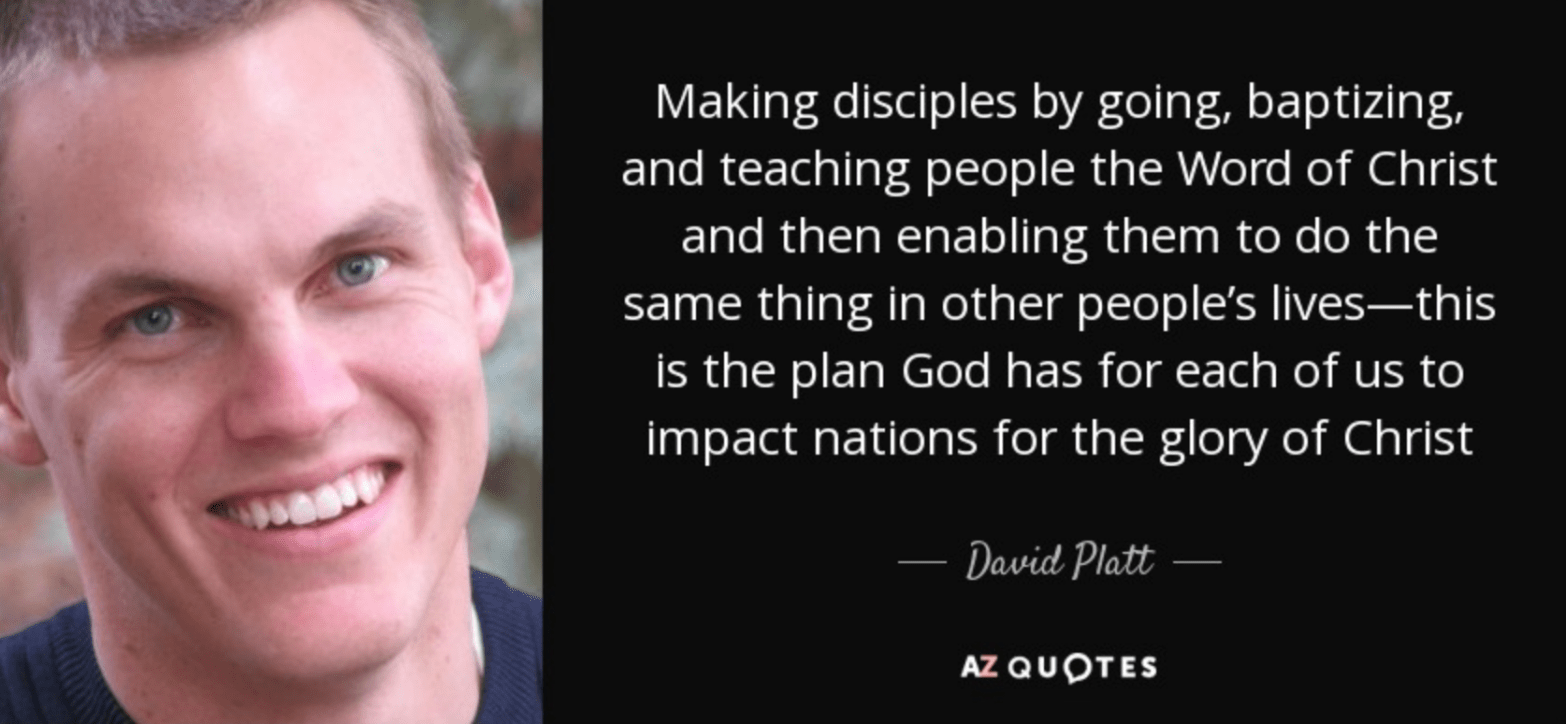
The Third Stage is Deployment, intentional global commissioning. The disciple must be willing to go where Jesus leads him to go. Robert Garrett states, “The greatest missionary in history was Jesus Christ.”[15] Disciples are sent; therefore, disciples must go. David Platt wrote, “Wherever you and I live, we are commanded to go and make disciples there. In light of Jesus’ example, our primary impact on the nations will occur in the disciple-making we do right around us.”[16] But even if the disciple does not go abroad, they are called to take the Gospel to the world within their own towns and cities. Christians can no longer sit on the sidelines and assume that missionary work is not what they were called to do. On the contrary, all Christians are called to be disciples, who make disciples, who make disciples.

The most effective way to accomplish the Great Commission is to multiply. Earley and Wheeler wrote, “When we lead people to Christ, we must stay with them to help them get established in their faith. Then they can be carriers of the good news, and the message of the gospel will multiply through their consistent witness.”[17]


[1] Dietrich Bonhoeffer, Dietrich Bonhoeffer Works, Volume 4 (Minneapolis: First Fortress Press, 2003), 57.

[2] Ibid., 57

[3] Ibid., 59

[4] Jim Putman, Bobby Harrington, and Robert E. Coleman, DiscipleShift: Five Steps That Help Your Church to Make Disciples Who Make Disciples (Grand Rapids: Zondervan, 2013) 44-45.

[5] Putman, DiscipleShift, 45.

[6] Putman, DiscipleShift, 46.

[7] Putman, DiscipleShift, 47.

[8] Putman, DiscipleShift, 48.

[9] Putman, DiscipleShift, 49

[10] Dave Earley and Rod Dempsey, Disciple Making Is…: How to Live the Great Commission with Passion and Confidence (Nashville: B&H Publishing Group, 2013) 77.

[11] Earley and Dempsey, Disciple Making Is, 62.

[12] Earley and Dempsey, Disciple Making Is, 61.

[13] Earley and Dempsey, Disciple Making Is, 68.

[14] Earley and Dempsey, Disciple Making Is, 69.

[15]Robert Garrett, “The Gospels and Acts: Jesus the Missionary and His Missionary Followers,” in Missiology (Nashville: B&H Publishing, 1998), 63.

[16] David Platt, Radical (Nashville, TN: Thomas Nelson, 2010), 198.

[17] Dave Earley and David Wheeler, Evangelism Is…:How to Share Jesus with Passion and Confidence (Nashville, TN: B&H Publishing Group, 2010), 134.

Bibliography

Bonhoeffer, Dietrich. Dietrich Bonhoeffer Works, Volume 4. Minneapolis, MN: First Fortress Press, 2003.

Earley, Dave, and David Wheeler. Evangelism Is…: How to Share Jesus with Passion and Confidence. Nashville, TN: B&H Publishing Group, 2010.

Earley, Dave, and Rod Dempsey. Disciple Making Is… How to Live the Great Commission with Passion and Confidence. Nashville, TN: B&H Academic, 2013.

Garrett, Robert. The Gospels and Acts: Jesus the Missionary and His Missionary Followers, in Missiology. Nashville, TN: B&H Publishing Group, 1998.

Platt, David. Radical. Nashville, TN: Thomas Nelson, 2010.

Putman, Jim, Bobby Harrington, and Robert E Coleman. Disciple Shift: Five Steps That Help Your Church to Make Disciples Who Make Disciples. Grand Rapids, MI: Zondervan, 2013.

This material is protected and may not be republished. Paper submitted to Dr. Morris Baker, Liberty University, in partial fulfillment of the requirements for the completion of DSMN500-D03, Discipleship Ministries, April 8, 2018 by Joseph T. Lee.

Joseph T. Lee Copyright © April 8, 2018, The Lantern & Shield Times LLC. All Rights Reserved. 

Exactly What Is a Follower of Jesus Christ?

Exactly, what is a Follower of Jesus Christ? According to Rod Dempsey, a follower of Jesus Christ is actually a disciple of Christ. There are many characteristics of being a follower of Christ. A follower of Christ has surrendered his all to Jesus. This is called sacrificial. According to Dempsey, “He or she has made a decision to submit to Christ and surrender their will to follow Christ no matter what the cost” (Earley and Dempsey, 2013, 27). The second characteristic of being a follower of Christ is relational. Dempsey wrote, “He or she understands that love is the hallmark of followers of Jesus Christ. Love for God, love for neighbor, and love for other disciples is a very important part of the value system of a disciple” (Earley and Dempsey, 27). The third characteristic of being a follower of Christ is transformational. Dempsey wrote, “He or she understands that the purpose of spiritual growth is directed toward becoming like Christ in word, thought, attitude, and action” (Earley and Dempsey, 27).


Putman, et al, states that there are three attributes to being a follower of Jesus Christ. They take this from Matthew 4:19, “And he said to them, follow me, and I will make you fishers of men” (ESV). Putman et al states that John 12:26 speaks of this process. John 14:23-24 speaks of this as well as anyone who loves Christ will love the Word of God and will obey His teaching. By following Christ, a transformation will occur and a hunger for the Word. The Word will help shape and develop the new believer into a seasoned disciple who then can become an influence on others to come to Christ (Putman, et al., 2013, 46-51).

My definition of a follower of Jesus Christ is one that has been introduced to the Gospel and he or she has accepted Jesus in their heart. They have confessed with their mouths that they are lost without Jesus and that they believe that Jesus is the Son of God, that He came into the world to save it and not to condemn it. They believe that Jesus died for their individual sins and he rose after three days and ascended to heaven. They are new believers, being transformed by the Holy Spirit and starting to live life differently from the rest of the world. But a true follower will not stop at this conversion. They will hunger for the Word and seek to get closer to God. They will become disciples of Jesus Christ.

Unfortunately, not everyone will come to Christ. According to 2 Tim 2:10 and 2 Peter 1:10, salvation is for the elect in Christ. John 6:44 states, “no one can come to me unless the Father who sent me draws him.” But there is hope in John 6:65 when Christ said, “This is why I told you that no one can come to me unless it is granted him by the Father.” What this is saying is that as a sinner, they have no way to save themselves. This is overcome by the sovereign power of the Holy Spirit, which will draw every man, woman, boy, and girl to Him who allows and yields to the Spirit.

Bibliography

Earley, Dave, and Rod Dempsey. Disciple Making Is… How to Live the Great Commission with Passion and Confidence. Nashville, TN: B&H Academic, 2013.

Putman, Jim, Bobby Harrington, and Robert E Coleman. Disciple Shift: Five Steps That Help Your Church to Make Disciples Who Make Disciples. Grand Rapids, MI: Zondervan, 2013.

Sproul, R C. The Reformation Study Bible: English Standard Version. Edited by R C Sproul. Orlando, FL: Reformation Trust Publishing, 2015.

Joseph T. Lee Copyright © March 31, 2018. The Lantern & Shield Times LLC. All Rights Reserved.


Breaking News: Jesus of Nazareth Has Risen from the Dead! The Tomb Is Empty!

April 17, 30 AD: At about 4:30 this morning, Mary Magdalene reports that she went to the Jesus’ tomb and found it open. She peered inside and saw that Jesus was nowhere in sight. His body was gone and his burial cloth was neatly folded up. According to John, “So she ran and went to Simon Peter and the other disciple, the one whom Jesus loved, and said to them, “They have taken the Lord out of the tomb, and we do not know where they have laid him.”  So, Peter went out with the other disciple, and they were going toward the tomb.  Both were running together, but the other disciple outran Peter and reached the tomb first.  And stooping to look in, he saw the linen cloths lying there, but he did not go in.  Then Simon Peter came, following him, and went into the tomb. He saw the linen cloths lying there, and the face cloth, which had been on Jesus’ head, not lying with the linen cloths but folded up in a place by itself.  Then the other disciple, who had reached the tomb first, also went in, and he saw and believed; for yet they did not understand the Scripture, that he must rise from the dead.  Then the disciples went back to their homes.”

John also stated, “But Mary stood weeping outside the tomb, and as she wept she stooped to look into the tomb.  And she saw two angels in white, sitting where the body of Jesus had lain, one at the head and one at the feet.  They said to her, “Woman, why are you weeping?” She said to them, “They have taken away my Lord, and I do not know where they have laid him.”  Having said this, she turned around and saw Jesus standing, but she did not know that it was Jesus.  Jesus said to her, “Woman, why are you weeping? Whom are you seeking?” Supposing him to be the gardener, she said to him, “Sir, if you have carried him away, tell me where you have laid him, and I will take him away.”  Jesus said to her, “Mary.” She turned and said to him in Aramaic, “Rabboni!” (which means Teacher). Jesus said to her, “Do not cling to me, for I have not yet ascended to the Father; but go to my brothers and say to them, ‘I am ascending to my Father and your Father, to my God and your God.’”  Mary Magdalene went and announced to the disciples, “I have seen the Lord”—and that he had said these things to her.”

In another eyewitness account, Luke states, “ That very day two of them were going to a village named Emmaus, about seven miles from Jerusalem,  and they were talking with each other about all these things that had happened.  While they were talking and discussing together, Jesus himself drew near and went with them. But their eyes were kept from recognizing him.  And he said to them, “What is this conversation that you are holding with each other as you walk?” And they stood still, looking sad.  Then one of them, named Cleopas, answered him, “Are you the only visitor to Jerusalem who does not know the things that have happened there in these days?”  And he said to them, “What things?” And they said to him, “Concerning Jesus of Nazareth, a man who was a prophet mighty in deed and word before God and all the people,  and how our chief priests and rulers delivered him up to be condemned to death, and crucified him.  But we had hoped that he was the one to redeem Israel. Yes, and besides all this, it is now the third day since these things happened.  Moreover, some women of our company amazed us. They were at the tomb early in the morning,  and when they did not find his body, they came back saying that they had even seen a vision of angels, who said that he was alive.  Some of those who were with us went to the tomb and found it just as the women had said, but him they did not see.”  And he said to them, “O foolish ones, and slow of heart to believe all that the prophets have spoken!  Was it not necessary that the Christ should suffer these things and enter into his glory?”  And beginning with Moses and all the Prophets, he interpreted to them in all the Scriptures the things concerning himself.”

Luke continues, “So they drew near to the village to which they were going. He acted as if he were going farther, but they urged him strongly, saying, “Stay with us, for it is toward evening and the day is now far spent.” So, he went in to stay with them. When he was at table with them, he took the bread and blessed and broke it and gave it to them.  And their eyes were opened, and they recognized him. And he vanished from their sight.  They said to each other, “Did not our hearts burn within us while he talked to us on the road, while he opened to us the Scriptures?” And they rose that same hour and returned to Jerusalem. And they found the eleven and those who were with them gathered together, saying, “The Lord has risen indeed, and has appeared to Simon!”  Then they told what had happened on the road, and how he was known to them in the breaking of the bread.”

Jesus appeared to his disciples. According to Luke, “ As they were talking about these things, Jesus himself stood among them, and said to them, “Peace to you!”  But they were startled and frightened and thought they saw a spirit. And he said to them, “Why are you troubled, and why do doubts arise in your hearts? See my hands and my feet, that it is I myself. Touch me, and see. For a spirit does not have flesh and bones as you see that I have. “And when he had said this, he showed them his hands and his feet. And while they still disbelieved for joy and were marveling, he said to them, “Have you anything here to eat?”  They gave him a piece of broiled fish, and he took it and ate before them.

Then he said to them, “These are my words that I spoke to you while I was still with you, that everything written about me in the Law of Moses and the Prophets and the Psalms must be fulfilled.”  Then he opened their minds to understand the Scriptures, and said to them, “Thus it is written, that the Christ should suffer and on the third day rise from the dead,  and that repentance for the forgiveness of sins should be proclaimed in his name to all nations, beginning from Jerusalem. You are witnesses of these things.  And behold, I am sending the promise of my Father upon you. But stay in the city until you are clothed with power from on high.”

It is reported that Jesus ascended to Heaven. Look at what our eyewitness Luke says, “And he led them out as far as Bethany, and lifting up his hands he blessed them.  While he blessed them, he parted from them and was carried up into heaven.  And they worshiped him and returned to Jerusalem with great joy, and were continually in the temple blessing God.”

Present Day: Surely, Jesus was truly the Son of God! He did rise again and that is why we celebrate Easter every year. Easter is not about the Easter Bunny, eggs, or candy. It is about the very Son of God, who died an agonizing death for the redemption of our sins. It is about the fulfillment of Scripture. In which God would give mankind another chance by sending His Own Son, into the world, not to condemn it, but to save it.

The Gospels are very clear. There is only one way to heaven and that is through Jesus Christ. Look at what the Scripture says about how to be saved:

Romans 3:23 – “For all have sinned and fall short of the glory of God.”

Romans 6:23 – “For the wages of sin is death, but the gift of God is eternal life in Christ Jesus our Lord.”

John 3:3 – “Jesus said, I assure you: Unless someone is born again, he cannot see the kingdom of God.”

John 14:6 – “I am the way, the truth, and the life; no one comes to the Father except through me.”

Romans 10:9-11 – “if you confess with your mouth that Jesus is Lord and believe in your heart that God raised him from the dead, you will be saved.  For with the heart one believes and is justified, and with the mouth one confesses and is saved. For the Scripture says, “Everyone who believes in him will not be put to shame.”

2 Corinthians 5:15 – “And He died for all so that those who live should no longer live for themselves, but for the One who died for them and was raised.”

John 3:16-17 – “For God so loved the world, that he gave his only Son, that whoever believes in him should not perish but have eternal life.  For God did not send his Son into the world to condemn the world, but in order that the world might be saved through him.”

Revelation 3:20 – “Behold, I stand at the door and knock. If anyone hears my voice and opens the door, I will come in to him and eat with him, and he with me.”

It is our hope that if you have been searching for the “Truth” that you would recognize that Jesus is the “Truth.” If you believe that Jesus is the Son of God and that He died for you and your guilt and sins and you also believe that He rose again in three days to show that He truly is the Son of God, then pray this prayer.

“Heavenly Father, I have sinned against You. I want your forgiveness for all my sins. I believe that Jesus died on the cross for me and rose again. Father, I give You my life to do with as You wish. I want Jesus Christ to come into my life and into my heart and live in me. I ask this in the name of Jesus. Amen.”

I pray that many who read this story will come to Christ Jesus and that you will know the saving Grace and Forgiveness only found through Jesus Christ. It is a life style change that will forever change your heart and your life. Once you come to Christ, Jesus will send His Holy Spirit to dwell with you and help to teach you, through the Word of God. Get affiliated with a true Bible believing church and become a disciple of Christ. Get engaged in the Word and develop a relationship with God. I know that God’s Not Dead because I speak with Him daily through prayer and through His Word. Having a true relationship with Jesus Christ is a way of life that I hunger for.

I hope that you find Jesus Christ today! Happy Easter! He Has Risen! He Has Risen Indeed!!!!!!

Sources: The Gospel of Luke and John, The Book of Romans, 2 Corinthians, and Revelation.

Original Copyright © April 1, 2018. The Lantern & Shield Times LLC. All Rights Reserved.

Republished Copyright 04/17/2022. Marketplace Evangelism Ministries Inc. All Rights Reserved.

Breaking News: Jesus Arrested, Convicted, Beaten, and Crucified

Spring, 30 AD. Early this morning at approximately 1:30 AM, Jesus was accosted and arrested in the Garden of Gethsemane by Temple Guards of the Sanhedrin. Judas, one of his disciples betrayed him for 30 pieces of silver. During the arrest, according to an eyewitness by the name of John, “Simon Peter, having a sword, drew it and struck the high priest’s servant and cut off his right ear. The servant’s name was Malchus. Jesus said to Peter, put your sword into its sheath; shall I not drink the cup that the Father has given me?” Another eyewitness by the name of Luke states, “Jesus said, “No more of this!” And he touched his ear and healed him.”

The reason Jesus was in the Garden was that he was praying. It is reported that earlier that night, he and his disciples enjoyed a supper together. Judas then left the group, and it is reported that he went directly to the Sanhedrin to sell out his Rabbi, Jesus. Afterwards, at about 1:00 AM, Jesus and the eleven remaining disciples went to the Garden to pray.

Jesus was then arrested and taken at night before the Sanhedrin to stand trial for his offenses. Now according to Jewish law, a trial at night is against the law, but apparently, the Sanhedrin felt that Jesus needed to be convicted right away. They took him to Caiaphas house to try to get a conviction and an immediate death sentence. In the Jewish trial Caiaphas asked, “Are you the Christ, the Son of the Blessed One?” Jesus answered “Yes.”

The following is Mark’s account, who was an eyewitness that went to the Palace of Caiaphas. Mark states, “Now the chief priests and the whole council were seeking testimony against Jesus to put him to death, but they found none.  For many bore false witness against him, but their testimony did not agree.  And some stood up and bore false witness against him, saying, “We heard him say, ‘I will destroy this temple that is made with hands, and in three days I will build another, not made with hands.’” Yet even about this their testimony did not agree. And the high priest stood up in the midst and asked Jesus, “Have you no answer to make? What is it that these men testify against you?”  But he remained silent and made no answer. Again, the high priest asked him, “Are you the Christ, the Son of the Blessed?”  And Jesus said, “I am, and you will see the Son of Man seated at the right hand of Power, and coming with the clouds of heaven.”  And the high priest tore his garments and said, “What further witnesses do we need? You have heard his blasphemy. What is your decision?” And they all condemned him as deserving death.  And some began to spit on him and to cover his face and to strike him, saying to him, “Prophesy!” And the guards received him with blows.”

They convicted him of proclaiming that he was the Son of God and King of the Jews. Those were his only crimes according to eyewitnesses. The Sanhedrin and Caiaphas pronounced sentence that he should die. Since the Sanhedrin could not actually carry out the sentence, they waited for morning to take Jesus before Pontius Pilate, who was the Roman official in charge of the region.

While in custody of the Sanhedrin, it is reported that the Temple guards struck Jesus several times. While Jesus was in custody, Peter, one of Jesus disciples, denied knowing him on three separate occasions that morning. It is reported that Jesus stated while having dinner with his disciples the night before that Peter would deny him three times before the rooster crowed. Jesus exact words as reported by Matthew, “Jesus said to Peter, Truly, I tell you, this very night, before the rooster crows, you will deny me three times.” On three separate occasions that morning, Peter in fact denied Jesus and when he realized it, Peter grieved.

At 6:30 AM, according to John, “they led Jesus from the house of Caiaphas to the governor’s headquarters. It was early morning. They themselves did not enter the governor’s headquarters, so that they would not be defiled, but could eat the Passover. So, Pilate went outside to them and said, “What accusation do you bring against this man?”  They answered him, “If this man were not doing evil, we would not have delivered him over to you.”  Pilate said to them, “Take him yourselves and judge him by your own law.” The Jews said to him, “It is not lawful for us to put anyone to death.” This was to fulfill the word that Jesus had spoken to show by what kind of death he was going to die. So, Pilate entered his headquarters again and called Jesus and said to him, “Are you the King of the Jews?”  Jesus answered, “Do you say this of your own accord, or did others say it to you about me?”  Pilate answered, “Am I a Jew? Your own nation and the chief priests have delivered you over to me. What have you done?”  Jesus answered, “My kingdom is not of this world. If my kingdom were of this world, my servants would have been fighting, that I might not be delivered over to the Jews. But my kingdom is not from the world.”  Then Pilate said to him, “So you are a king?” Jesus answered, “You say that I am a king. For this purpose, I was born and for this purpose I have come into the world—to bear witness to the truth. Everyone who is of the truth listens to my voice.”  Pilate said to him, “What is truth?” But you have a custom that I should release one man for you at the Passover. So, do you want me to release to you the King of the Jews?”  They cried out again, “Not this man, but Barabbas!” Now Barabbas was a robber. Then Pilate took Jesus and flogged him. And the soldiers twisted together a crown of thorns and put it on his head and arrayed him in a purple robe. They came up to him, saying, “Hail, King of the Jews!” and struck him with their hands.  Pilate went out again and said to them, “See, I am bringing him out to you that you may know that I find no guilt in him.”  So, Jesus came out, wearing the crown of thorns and the purple robe. Pilate said to them, “Behold the man!”  When the chief priests and the officers saw him, they cried out, “Crucify him, crucify him!” Pilate said to them, “Take him yourselves and crucify him, for I find no guilt in him.”

John goes on to describe what happened next. “The Jews answered him, “We have a law, and according to that law he ought to die because he has made himself the Son of God.”  When Pilate heard this statement, he was even more afraid.  He entered his headquarters again and said to Jesus, “Where are you from?” But Jesus gave him no answer.  So, Pilate said to him, “You will not speak to me? Do you not know that I have authority to release you and authority to crucify you?”  Jesus answered him, “You would have no authority over me at all unless it had been given you from above. Therefore, he who delivered me over to you has the greater sin.”

From then on Pilate sought to release him, but the Jews cried out, “If you release this man, you are not Caesar’s friend. Everyone who makes himself a king opposes Caesar.” So, when Pilate heard these words, he brought Jesus out and sat down on the judgment seat at a place called The Stone Pavement, and in Aramaic Gabbatha.  Now it was the day of Preparation of the Passover. It was about the sixth hour. He said to the Jews, “Behold your King!”  They cried out, “Away with him, away with him, crucify him!” Pilate said to them, “Shall I crucify your King?” The chief priests answered, “We have no king but Caesar.” So, he delivered him over to them to be crucified.”

Our eyewitness, John, saw the entire account. John stated that after they beat him within an inch of his life, they made him carry a cross throughout the town streets with a cloak and a crown of thorns pierced on his head. Jesus was in such agony. He was bloody and thirsty and so weak that he could barely walk. The wooden cross beam was so heavy that the Romans forced another Jewish man to help him carry the beam.

John states, “So they took Jesus, and he went out, bearing his own cross, to the place called The Place of a Skull, which in Aramaic is called Golgotha. There they crucified him, and with him two others, one on either side, and Jesus between them. Pilate also wrote an inscription and put it on the cross. It read, “Jesus of Nazareth, the King of the Jews.”  Many of the Jews read this inscription, for the place where Jesus was crucified was near the city, and it was written in Aramaic, in Latin, and in Greek.  So, the chief priests of the Jews said to Pilate, “Do not write, ‘The King of the Jews,’ but rather, ‘This man said, I am King of the Jews.’” Pilate answered, “What I have written I have written.”

When the soldiers had crucified Jesus, they took his garments and divided them into four parts, one part for each soldier; also, his tunic. But the tunic was seamless, woven in one piece from top to bottom, so they said to one another, “Let us not tear it, but cast lots for it to see whose it shall be.” This was to fulfill the Scripture which says,

“They divided my garments among them,
and for my clothing they cast lots.”

So, the soldiers did these things, but standing by the cross of Jesus were his mother and his mother’s sister, Mary the wife of Clopas, and Mary Magdalene. When Jesus saw his mother and the disciple whom he loved standing nearby, he said to his mother, “Woman, behold, your son!”  Then he said to the disciple, “Behold, your mother!” And from that hour the disciple took her to his own home.

It was about 3:00 PM according to John. John states, “After this, Jesus, knowing that all was now finished, said, “I thirst.” A jar full of sour wine stood there, so they put a sponge full of the sour wine on a hyssop branch and held it to his mouth.  When Jesus had received the sour wine, he said, “It is finished,” and he bowed his head and gave up his spirit.”

Since it was the day of Preparation, and so that the bodies would not remain on the cross on the Sabbath, the Jews asked Pilate that their legs might be broken and that they might be taken away.  So, the soldiers came and broke the legs of the first, and of the other who had been crucified with him.  But when they came to Jesus and saw that he was already dead, they did not break his legs.  But one of the soldiers pierced his side with a spear, and at once there came out blood and water.  He who saw it has borne witness—his testimony is true, and he knows that he is telling the truth—that you also may believe.  For these things took place that the Scripture might be fulfilled: “Not one of his bones will be broken.”  And again, another Scripture says, “They will look on him whom they have pierced.”

“After these things Joseph of Arimathea, who was a disciple of Jesus, but secretly for fear of the Jews, asked Pilate that he might take away the body of Jesus, and Pilate gave him permission. So, he came and took away his body. Nicodemus also, who earlier had come to Jesus by night, came bringing a mixture of myrrh and aloes, about seventy-five pounds in weight.  So, they took the body of Jesus and bound it in linen cloths with the spices, as is the burial custom of the Jews.  Now in the place where he was crucified there was a garden, and in the garden a new tomb in which no one had yet been laid.  So, because of the Jewish day of Preparation, since the tomb was close at hand, they laid Jesus there.”

In another eyewitness account, Matthew states, “Now from the sixth hour there was darkness over all the land until the ninth hour.  And about the ninth hour Jesus cried out with a loud voice, saying, “Eli, Eli, lema sabachthani?” that is, “My God, my God, why have you forsaken me?” And some of the bystanders, hearing it, said, “This man is calling Elijah.”  And one of them at once ran and took a sponge, filled it with sour wine, and put it on a reed and gave it to him to drink.  But the others said, “Wait, let us see whether Elijah will come to save him.”  And Jesus cried out again with a loud voice and yielded up his spirit.

And behold, the curtain of the temple was torn in two, from top to bottom. And the earth shook, and the rocks were split.  The tombs also were opened. And many bodies of the saints who had fallen asleep were raised, and coming out of the tombs after his resurrection they went into the holy city and appeared to many. When the centurion and those who were with him, keeping watch over Jesus, saw the earthquake and what took place, they were filled with awe and said, “Truly this was the Son of God!”

There were also many women there, looking on from a distance, who had followed Jesus from Galilee, ministering to him, among whom were Mary Magdalene and Mary the mother of James and Joseph and the mother of the sons of Zebedee.”

In previous accounts, Jesus had said that he would die for the redemption of sin. It is reported that he said that after he died, he would rise again. We will see what happens as today is Friday afternoon, and He said He would rise from the dead on Sunday.

Sources:

The Gospels of Matthew, Mark, Luke, and John.

Republished: Copyright © April 2, 2021. Marketplace Evangelism Ministries Inc. All Rights Reserved.


Do You Pray For Your Leaders?

Just this morning, I had breakfast with a group of older people at a local fast food restaurant. Everything was going well until someone started talking about the anti-Christ. An eighty-nine year old women piped up and exclaimed that President Obama was the anti-Christ. I then told her that he certainly was not the anti-Christ. But this woman was so filled with prejudiced hatred that no one could convince her otherwise. She is a gray headed Caucasian woman who was set in her ways. Although she proclaims to be a Christian, she had a hatred for Obama. My concern for her as well as others like her is that she is truly lost because as a Christian, you cannot have hatred for another. The Holy Spirit cannot occupy your heart and yet one has hatred for others in it.

We can live in a country and say the most hurtful and mean things about POTUS and not worry about losing our lives. This woman said that the country was lost and needed to change and yet she cannot see her own sin because of her prejudiced outlook on people of a different color and race.  If we want to see change in our nation, then the change most start with each individual person within their own hearts. People who are filled with so much hatred for those of a different race, I believe it just shows the true “you” and a dark heart that has no love.

The very freedoms a US Citizen has in America was won on the deaths and sacrifices of the US Armed Forces. Before criticizing your POTUS with hateful remarks, why not consider praying for him? After all, we are called to pray! We are called to pray for our neighbors and get this, even our enemies. Regardless of your political stance, why not consider espousing LOVE as opposed to hate? It is easier to forgive than to carry the burden of a grudge.

The fact that proclaimed Believers participate in this type of behavior means that they still have a heart problem. Maybe they truly are not “real Christians.” Maybe they are even using “Christianity” as a political tool. Whatever their motive, by speaking “evil words” against a man or a woman means that one does not have the Love of Christ in their heart.

I don’t know what kind of god you worship or affiliate with? But my God can overcome! My God can heal hearts! My God can forgive trespasses! My God can help people to overcome!

So, why should we pray for a man or woman in leadership whom we do not care for? Because by praying for them, we are asking God to intervene for us that they will do the right thing. My God can change hearts and can save people from their sins.

Why pray for leaders to fear God? When someone leads and lives their life fearing God, they experience:

1. Wisdom
2. Knowledge
3. Understanding
4. Eternal Praise
5. Victory
6. God’s Protection
7. A Blameless Walk
8. Length of Life
9. Wealth and Honor
10. Humility
11. The Avoidance of Evil
12. Being Untouched by Trouble
13. The Saving of a Crushed Spirit
14. A Life That Lacks Nothing

Credit: Dr. Mark Becton taken from sermon preached on 01/22/2017, at Grove Avenue Baptist Church.

These fourteen points is all the reason to pray for your leaders, regardless of whether you like them or not. We are called to pray and to show the love of Christ to those who do not know Him, even if it is your POTUS!

James 5:16 says, “Therefore, confess your sins to one another and pray for one another, that you may be healed. The prayer of a righteous person has great power as it is working.”

1 Timothy 2:1 says, “First of all, then, I urge that supplications, prayers, intercessions, and thanksgivings be made for all people.”

Philippians 4:6, “Do not be anxious about anything, but in everything by prayer and supplication with thanksgiving let your requests be made known to God.”

Matthew 18:19, “Again I say to you, if two of you agree on earth about anything they ask, it will be done for them by my Father in heaven.”

Matthew 6:9-13, “Pray then like this: “Our Father in heaven, hallowed be your name. Your kingdom come, your will be done, on earth as it is in heaven. Give us this day our daily bread, and forgive us our debts, as we also have forgiven our debtors. And lead us not into temptation, but deliver us from evil.”

Remember, before criticizing others, look at your own life. If you are without sin, then cast the first stone! But in reality, your life is just as filthy as the life that you are criticizing. Look at Romans 3:23, “For all have sinned and fall short of the glory of God.” We all have sin in our own lives. So, before you criticize POTUS or any other leader, consider cleaning up your own life before trying to straighten out the lives of others! This is exactly why we must be praying for others as well as have others to pray for us! GOD CAN! HE CAN OVERCOME!

If you want to see change, then start by analyzing your own life, asking forgiveness, and then living your life for God. Also pray for your leaders, even the ones you do not care for. It will make the difference in our nation as well as in our own lives.

Joseph T. Lee, Copyright © March 26, 2018, The Lantern & Shield Times LLC. All Rights Reserved.